Human–AI Collaboration in Marketing: How to Combine Human Insight & AI Power in 2025
Category: Content Marketing
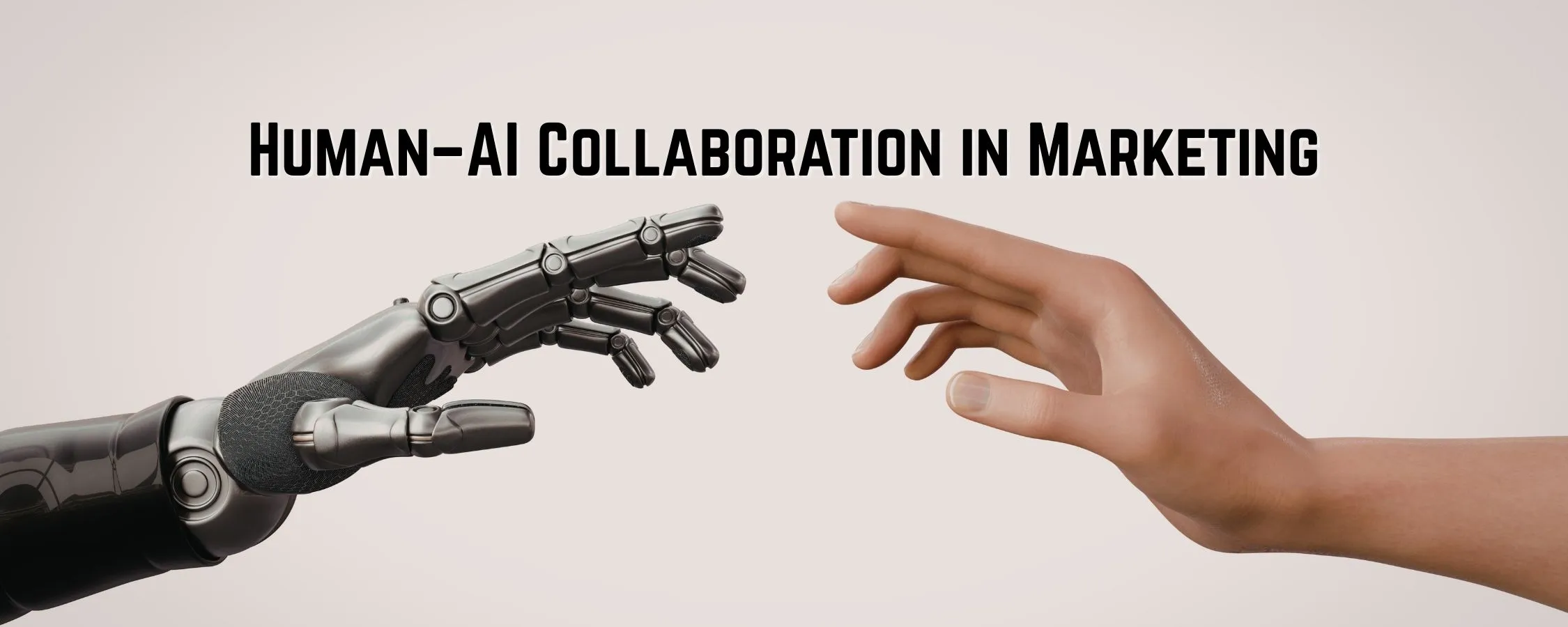
Marketing has entered a new era. The most successful teams aren't choosing between human creativity and artificial intelligence-they're combining both.
Human AI collaboration marketing is reshaping how brands connect with customers. From personalized email campaigns to data-driven ad creative, the partnership between marketers and AI tools creates results neither could achieve alone.
The benefits are clear: faster content production, smarter personalization, deeper customer insights and campaigns that actually resonate. But there's a catch. AI-human collaboration only works when humans stay in control. Pure AI marketing creates generic messages, factual errors and tone-deaf campaigns that damage brands.
The winning formula? Let AI handle the heavy lifting-data analysis, drafts, automation-while humans provide strategy, creativity, emotional intelligence and ethical oversight.
This complete guide covers everything you need to master human-in-the-loop marketing:
- A proven 7-step hybrid workflow
- Real marketing use cases with examples
- Best practices and common pitfalls
- Tools for every stage of the process
- A case study with measurable results
- Predictions for 2025-2030
Let's build your human-AI marketing machine.
What Is Human–AI Collaboration in Marketing?
Human–AI collaboration in marketing is a working approach where artificial intelligence tools and human marketers combine their strengths to create, optimize and deliver marketing campaigns. AI handles data analysis, automation, content drafts and personalization at scale, while humans provide strategic direction, creative judgment, emotional intelligence, brand voice and ethical oversight. This collaborative intelligence model produces faster, smarter, more personalized marketing than either humans or AI could achieve independently.
Think of it as a relay race. AI sprints through the data-heavy, repetitive tasks. Humans run the legs that require judgment, creativity and connection. Together, you cross the finish line faster-and with better results.
Why Human–AI Collaboration Matters in Modern Marketing
The days of debating "human vs. machine" are over. Today's question is: "How do we work together effectively?"
Here's why AI augmented marketing has become essential:
⚡ Faster Content Production
- AI generates first drafts in minutes, not days
- Teams produce 3-5x more content with same resources
- Reduced time from idea to published campaign
- More bandwidth for strategic, creative work
🎯 Improved Personalization at Scale
- AI analyzes thousands of customer data points instantly
- Personalized messaging for segments of any size
- Dynamic content that adapts to individual behaviors
- Humans set personalization strategy and boundaries
💡 Enhanced Creativity Through AI Ideation
- AI suggests angles and ideas humans might miss
- Rapid generation of headline and copy variations
- Creative teams focus on refining, not starting from zero
- More experimentation, faster iteration
📊 Data-Driven Decision Making
- AI processes complex datasets in seconds
- Pattern recognition across millions of interactions
- Predictive insights for campaign optimization
- Humans interpret data and make strategic choices
🎨 Human Oversight for Brand Voice & Ethics
- AI follows guidelines; humans feel the brand
- Protection against tone-deaf messaging
- Ethical review prevents bias and harmful content
- Consistent brand personality across all channels
😊 Better Customer Experience
- Faster responses through AI automation
- Human escalation for complex issues
- Personalized journeys that feel authentic
- Right message, right time, right channel
📈 Increased Marketing ROI
- Lower content production costs
- Higher conversion through personalization
- Reduced wasted ad spend via AI optimization
- More campaigns tested with same budget
Human vs. AI - What Each Does Best in Marketing
Understanding the division of labor is crucial for effective AI marketing workflows. Here's what each brings to the table:
| Capability | Humans Excel At | AI Excels At |
|---|---|---|
| Strategic Thinking | Setting goals, defining target audiences, choosing positioning | Analyzing competitive data to inform strategy |
| Creativity | Original concepts, storytelling, emotional narratives | Generating variations, suggesting combinations |
| Empathy | Understanding human emotions, cultural nuances | Identifying patterns in sentiment data |
| Brand Voice | Defining and maintaining authentic personality | Mimicking voice with proper guidance |
| Ethical Judgment | Recognizing what's appropriate, fair and right | Flagging potential issues for human review |
| Data Processing | Interpreting meaning and implications | Processing millions of data points in seconds |
| Content Creation | Adding unique insights, personal experience, emotion | Drafting content quickly, creating variations |
| Automation | Designing automation rules and logic | Executing automation at massive scale |
| Personalization | Deciding personalization strategy and limits | Implementing personalization across thousands |
| Analysis | Drawing strategic conclusions | Identifying patterns, predicting outcomes |
| Customer Relationships | Building genuine connections, handling complex issues | Managing routine interactions, gathering data |
| Speed | Quality thinking (slower) | Processing and output (faster) |
The key insight: AI amplifies human capabilities. Humans guide AI output. Neither replaces the other.
The Human–AI Hybrid Marketing Workflow (7 Steps)
This comprehensive AI marketing workflow ensures quality at every stage. Follow these steps for campaigns that are fast, smart and authentically human.
Step 1: Strategy & Campaign Planning
Purpose: Define what you're trying to achieve before any content is created.
What Humans Do:
- Set campaign objectives and KPIs
- Define target audience personas
- Choose brand positioning and messaging themes
- Allocate budget and resources
- Make final strategic decisions
What AI Does:
- Analyze historical campaign performance
- Research competitor strategies and messaging
- Identify audience behavior patterns
- Suggest timing and channel recommendations
- Generate initial campaign brief drafts
Tools to Use:
- ChatGPT or Claude (strategic brainstorming)
- Semrush or Similarweb (competitive analysis)
- Google Analytics 4 (historical data)
- Notion or Asana (campaign planning)
Example Prompt:
Analyze the top 5 competitors in the project management software space. Identify their primary messaging themes, target audience focus and content gaps we could exploit. Present findings in a table format with strategic recommendations.
Example Human Edit:
AI suggests targeting "small businesses seeking efficiency." Human strategist refines to "overwhelmed marketing managers at growing startups who need to prove ROI to skeptical leadership"-adding emotional specificity and strategic focus.
Step 2: Data Research & Insight Discovery
Purpose: Gather the customer insights and market intelligence that inform creative decisions.
What Humans Do:
- Interpret data meaning and implications
- Conduct customer interviews and surveys
- Identify insights that matter strategically
- Connect data points to human motivations
- Validate AI-generated insights
What AI Does:
- Process large customer data sets
- Identify patterns and correlations
- Summarize research reports and studies
- Analyze social listening data
- Generate insight hypotheses
Tools to Use:
- Perplexity AI (research with sources)
- Brandwatch or Sprout Social (social listening)
- Tableau or Looker (data visualization)
- Survey tools + AI analysis
Example Prompt:
Analyze these customer survey responses and identify the top 5 pain points mentioned. For each pain point, provide the percentage of mentions, representative quotes and potential messaging angles we could use to address it.
Example Human Edit:
AI identifies "lack of time" as the top pain point. Human researcher digs deeper, recognizing the underlying issue is "fear of looking incompetent to leadership"-a more powerful emotional insight for messaging.
Step 3: AI-Assisted Ideation & Drafting
Purpose: Generate creative concepts and initial content drafts quickly.
What Humans Do:
- Provide detailed creative briefs
- Select the strongest concepts from AI suggestions
- Add unique perspectives and experiences
- Inject original ideas AI couldn't conceive
- Guide tone and messaging direction
What AI Does:
- Generate multiple headline options
- Create first drafts of copy
- Suggest creative angles and hooks
- Develop content variations for testing
- Produce visual concepts and descriptions
Tools to Use:
- Claude or GPT-4 (long-form drafting)
- Jasper (marketing copy)
- Copy.ai (short-form variations)
- Midjourney or DALL-E (visual concepts)
Example Prompt:
Write 10 email subject lines for a B2B software company launching a new automation feature. Target audience: overwhelmed marketing managers. Tone: empathetic but confident. Include curiosity-driven hooks and benefit-focused options. Avoid clickbait.
Example Human Edit:
AI suggests: "Introducing Our New Automation Feature"
Human rewrites: "That 3-hour task? Now takes 3 minutes. (New feature inside)"
Step 4: Human Review & Creative Enhancement
Purpose: Transform AI drafts into polished, brand-aligned content that connects emotionally.
What Humans Do:
- Rewrite introductions and key emotional moments
- Add storytelling, analogies and personality
- Ensure message clarity and flow
- Verify all claims and statistics
- Polish language for impact
What AI Does:
- Suggest alternative phrasings
- Check grammar and readability
- Identify potential clarity issues
- Generate additional examples or supporting points
Tools to Use:
- Google Docs (collaborative editing)
- Grammarly (grammar and clarity)
- Hemingway Editor (readability)
- Brand style guide reference
Example Prompt:
Review this email draft and suggest 3 ways to make the opening more emotionally engaging. The current version feels too corporate. We want readers to feel understood, not sold to.
Example Human Edit:
AI draft: "We understand that marketers face many challenges in today's competitive landscape."
Human rewrite: "You hit 'send' on that campaign at midnight. Again. We built something so you don't have to."
Step 5: AI Automation for Personalization
Purpose: Scale personalized experiences across thousands of customer touchpoints.
What Humans Do:
- Design personalization strategy and rules
- Set boundaries on what can be personalized
- Create segment definitions
- Monitor personalization quality
- Handle edge cases and exceptions
What AI Does:
- Dynamically personalize content in real-time
- Match content to individual user behaviors
- Optimize send times and channels
- A/B test personalization approaches
- Scale personalization across millions
Tools to Use:
- HubSpot or Marketo (marketing automation)
- Dynamic Yield or Optimizely (website personalization)
- Salesforce Marketing Cloud (multi-channel)
- Klaviyo (e-commerce personalization)
Example Prompt:
Create a personalization matrix for our email welcome series. Define 4 customer segments based on acquisition source, then outline how subject lines, email body content and CTAs should differ for each segment.
Example Human Edit:
AI suggests personalization based on demographics alone. Human marketer adds behavioral triggers-like personalization based on which feature the user explored first during signup-for more relevant messaging.
Step 6: Human Oversight for Ethics & Brand Voice
Purpose: Ensure all marketing is ethical, appropriate and authentically on-brand.
What Humans Do:
- Review content for bias and sensitivity
- Ensure legal and regulatory compliance
- Verify brand voice consistency
- Make final judgment calls on appropriateness
- Approve content before publication
What AI Does:
- Flag potentially sensitive content
- Check against brand voice guidelines
- Identify possible compliance issues
- Suggest alternative approaches for flagged items
Tools to Use:
- Writer.com (brand voice and compliance)
- Legal review checklist
- Internal ethics guidelines
- Bias detection tools
Example Prompt:
Review this marketing campaign for potential bias, cultural insensitivity or messaging that could alienate any audience segment. Flag specific phrases and explain why they might be problematic. Suggest inclusive alternatives.
Example Human Edit:
AI flags nothing. Human reviewer notices imagery only shows one demographic, recommends diverse representation in visuals to reflect actual customer base.
Step 7: Performance Analysis & Optimization (AI + Human)
Purpose: Measure results, learn insights and continuously improve.
What Humans Do:
- Set meaningful success metrics
- Interpret what results mean strategically
- Make decisions about next steps
- Connect performance to business goals
- Share learnings across the organization
What AI Does:
- Track and aggregate performance data
- Identify statistically significant patterns
- Predict future performance
- Recommend optimization actions
- Automate routine reporting
Tools to Use:
- Google Analytics 4 (web analytics)
- Mixpanel or Amplitude (product analytics)
- Supermetrics (data aggregation)
- AI-powered dashboards
Example Prompt:
Analyze these email campaign results across 6 segments. Identify which subject line themes performed best for each segment, what time/day combinations drove highest opens and recommend 3 specific tests for the next campaign based on the data.
Example Human Edit:
AI recommends optimizing for open rates. Human strategist shifts focus to conversion rates, recognizing that high opens with low conversions indicate a message-expectation mismatch that needs addressing.
Real Marketing Use Cases of Human–AI Collaboration
Here's how AI + human creativity works across different marketing functions:
📧 Email Marketing
What AI Does:
- Generates subject line variations
- Creates personalized email body content
- Optimizes send times per recipient
- Predicts which subscribers need re-engagement
- Drafts entire email sequences
What Humans Refine:
- Finalize subject lines for brand voice
- Add personal stories and emotional hooks
- Review personalization for appropriateness
- Make strategic decisions about frequency
- Handle sensitive customer communications
Example Result: A SaaS company uses AI to generate 20 subject line options per email. Human marketers select the top 3, refine them for brand voice and A/B test. Open rates increase 34%.
✍️ Content Creation
What AI Does:
- Generates first drafts of blog posts
- Creates content outlines and structures
- Suggests headlines and subheadings
- Repurposes content across formats
- Produces social media variations
What Humans Refine:
- Add unique expertise and perspectives
- Fact-check all claims and statistics
- Inject personality and storytelling
- Ensure SEO optimization reads naturally
- Final quality approval
Example Result: A marketing agency increases blog output from 8 to 30 posts monthly. AI handles drafts; human editors spend time on quality instead of starting from scratch. Traffic grows 156% in 6 months.
🎨 Ad Creative Optimization
What AI Does:
- Generates multiple ad copy variations
- Creates image and video concepts
- Predicts which creative elements will perform
- Automatically tests combinations
- Optimizes in real-time based on performance
What Humans Refine:
- Set creative strategy and positioning
- Ensure brand consistency across variations
- Review for cultural sensitivity
- Make judgment calls on edgy creative
- Analyze what the data really means
Example Result: An e-commerce brand uses AI to generate 50 ad variations weekly. Human creative directors approve top performers. Cost per acquisition drops 28% while maintaining brand standards.
📊 Predictive Analytics
What AI Does:
- Identifies customers likely to churn
- Predicts lifetime customer value
- Forecasts campaign performance
- Spots emerging trends in data
- Segments customers by behavior patterns
What Humans Refine:
- Interpret predictions in business context
- Decide which predictions to act on
- Design interventions and responses
- Validate model accuracy over time
- Connect insights to strategy
Example Result: A subscription company uses AI to predict churn 60 days in advance. Human marketers design personalized retention campaigns. Churn reduces 23%.
👥 Customer Segmentation
What AI Does:
- Clusters customers by behavior patterns
- Identifies micro-segments humans would miss
- Dynamically updates segments in real-time
- Predicts segment migration
- Recommends segment-specific messaging
What Humans Refine:
- Name and define segments meaningfully
- Decide which segments to prioritize
- Create segment-specific strategies
- Validate segments make business sense
- Develop personas from data clusters
Example Result: AI identifies a previously unknown segment of "quiet loyalists"-customers who rarely engage but consistently purchase. Humans create a VIP appreciation campaign, increasing their purchase frequency 41%.
📱 Social Media Workflows
What AI Does:
- Generates post ideas and drafts
- Schedules content for optimal timing
- Monitors brand mentions and sentiment
- Identifies trending topics to join
- Creates variations for different platforms
What Humans Refine:
- Add real-time cultural relevance
- Ensure humor lands appropriately
- Respond to complex customer issues
- Build genuine community relationships
- Make judgment calls on controversial topics
Example Result: A retail brand uses AI to draft 80% of routine social posts. Human managers focus on real-time engagement, crisis response and creative campaigns. Engagement increases 67% while team size stays the same.
🤖 Chatbots + Human Escalation
What AI Does:
- Handles routine customer inquiries
- Answers common questions instantly
- Qualifies leads and gathers information
- Processes simple transactions
- Available 24/7 with consistent responses
What Humans Refine:
- Handle complex or emotional situations
- Make exceptions when appropriate
- Build relationships with high-value customers
- Provide expertise AI can't offer
- Continuously train AI on new scenarios
Example Result: A financial services company routes 75% of inquiries through AI chatbots. Complex cases go to human advisors who now have more time per customer. Satisfaction scores increase 31%.
Best Practices for Effective Human–AI Collaboration
Follow these AI marketing workflows best practices for optimal results:
1. Start with Strategy, Not Tools
Define your marketing goals before choosing AI tools. The best AI implementation starts with a clear understanding of what you're trying to achieve and where AI can genuinely help.
2. Use AI for Rough Drafts, Humans for Final Polish
Let AI handle first drafts and variations. Reserve human time for the work that requires judgment: refining voice, adding insight and ensuring quality.
3. Implement Human-in-the-Loop Review Steps
Build mandatory human review into every workflow. Never publish AI content without human eyes. Create checkpoints for accuracy, brand voice and ethical review.
4. Create Comprehensive Brand Voice Guidelines
Document your brand voice in detail: tone, vocabulary, personality traits, do's and don'ts. Include this in AI prompts and train tools like Writer.com on your style.
5. Establish AI Governance Policies
Create clear policies for AI use in your organization. Define what AI can and can't do, disclosure requirements, approval processes and accountability structures.
6. Verify Everything AI Claims
Never trust AI statistics, quotes or factual claims without verification. AI hallucinates confidently. Build fact-checking into every workflow.
7. Maintain Transparency with Audiences
Decide your disclosure policy for AI-assisted content. Many brands now note "Created with AI assistance" or similar. Transparency builds trust.
8. Train Teams on Effective AI Use
Don't assume everyone knows how to work with AI effectively. Invest in training for prompt engineering, AI tool proficiency and human-AI workflow integration.
9. Start Small and Scale Gradually
Begin with one use case-like email subject lines or social posts-before expanding. Perfect one workflow, then replicate it across other areas.
10. Measure AI Impact Carefully
Track how AI collaboration affects key metrics: production speed, content quality, performance outcomes and team satisfaction. Let data guide your expansion.
11. Keep Humans in Creative Control
AI suggests; humans decide. Maintain human authority over creative direction, brand positioning and strategic choices. AI is a tool, not a replacement for marketing judgment.
12. Regularly Audit AI Outputs for Bias
AI can perpetuate biases from training data. Regularly review outputs for gender bias, cultural insensitivity, stereotypes or exclusionary language.
Tools That Enable Human–AI Collaboration in Marketing (2025)
Build your complete marketing automation with AI stack:
🤖 Large Language Models (LLMs)
| Tool | Best For | Price Range |
|---|---|---|
| ChatGPT (GPT-4) | All-purpose marketing content, versatile | Free-$20/month |
| Claude | Long-form content, nuanced messaging | Free-$20/month |
| Gemini | Google ecosystem integration, research | Free-$20/month |
| Jasper | Marketing-specific copy, campaigns | $49+/month |
📈 SEO & Content Tools
| Tool | Best For | Price Range |
|---|---|---|
| Surfer SEO | Content optimization, scoring | $89+/month |
| Clearscope | Enterprise content intelligence | $170+/month |
| Semrush | All-in-one SEO and competitive | $130+/month |
| MarketMuse | Content strategy and planning | $149+/month |
⚙️ Marketing Automation Platforms
| Tool | Best For | Price Range |
|---|---|---|
| HubSpot | All-in-one marketing automation | $800+/month |
| Marketo | Enterprise B2B automation | Custom pricing |
| Klaviyo | E-commerce email and SMS | $45+/month |
| ActiveCampaign | SMB automation with AI features | $29+/month |
🎯 Personalization Engines
| Tool | Best For | Price Range |
|---|---|---|
| Dynamic Yield | Website personalization | Custom pricing |
| Optimizely | Experimentation and personalization | Custom pricing |
| Insider | Multi-channel personalization | Custom pricing |
🎨 Creative Design Tools
| Tool | Best For | Price Range |
|---|---|---|
| Canva | Quick visual content creation | Free-$13/month |
| Midjourney | AI image generation | $10+/month |
| Adobe Firefly | Enterprise AI creative | Included with CC |
| Runway | AI video generation and editing | $12+/month |
📊 Analytics & Attribution
| Tool | Best For | Price Range |
|---|---|---|
| Google Analytics 4 | Web analytics | Free |
| Mixpanel | Product analytics | Free-$25+/month |
| Supermetrics | Data aggregation | $39+/month |
| Northbeam | Multi-touch attribution | Custom pricing |
Common Pitfalls (and How to Avoid Them)
Avoid these mistakes in your human supervised AI marketing approach:
❌ Pitfall 1: Over-Relying on AI Without Human Review
The Problem: Publishing AI content directly leads to errors, generic messaging and brand damage.
The Fix: Implement mandatory human review at every stage. No AI content goes live without human approval.
❌ Pitfall 2: Creating Generic, Undifferentiated Content
The Problem: AI-generated content often sounds like everyone else because it's trained on common patterns.
The Fix: Add unique insights original data, customer stories and brand personality during human editing. Differentiation comes from humans.
❌ Pitfall 3: Trusting AI "Facts" Without Verification
The Problem: AI confidently states things that aren't true-inventing statistics, studies and quotes.
The Fix: Verify every factual claim against authoritative sources. If you can't find verification, remove it.
❌ Pitfall 4: Ignoring Bias in AI-Generated Content
The Problem: AI can perpetuate harmful stereotypes and biases from its training data.
The Fix: Train reviewers to spot bias. Regularly audit content for representation, language and assumptions.
❌ Pitfall 5: Losing Brand Voice Consistency
The Problem: AI produces content that could be from any brand-missing your unique personality.
The Fix: Create detailed brand voice documentation. Include voice guidelines in every prompt. Assign brand voice experts as final reviewers.
❌ Pitfall 6: Skipping Strategy and Going Straight to Execution
The Problem: Teams use AI to produce content without clear strategic direction, wasting resources.
The Fix: Always define objectives, audience and success metrics before generating content.
❌ Pitfall 7: Failing to Train Teams Properly
The Problem: Marketers use AI ineffectively because they don't understand prompt engineering or workflow integration.
The Fix: Invest in AI training for your team. Create internal best practices documentation. Share effective prompts.
❌ Pitfall 8: Not Disclosing AI Use When Required
The Problem: Failing to disclose AI involvement can damage trust and violate regulations in some industries.
The Fix: Create a clear disclosure policy. When in doubt, be transparent.
Case Study: How "Velocity Marketing" Transformed Results with Human–AI Collaboration
- Company: Velocity Marketing (fictional mid-size marketing agency)
- Team Size: 15 marketers serving 12 clients
- Challenge: Clients demanding 3x more content with same budget
The Situation
Velocity's clients needed more content-blog posts, emails, social content, ad creative-but budgets weren't increasing. The agency faced a choice: decline work, lower quality or find a better way.
The Human–AI Collaboration Approach
They implemented a structured AI augmented marketing workflow:
Phase 1: Foundation (Month 1)
- Selected tools: Claude for long-form, Jasper for ads, Canva for visuals
- Created brand voice documentation for each client
- Trained team on effective prompting
Phase 2: Workflow Development (Month 2)
- Built 7-step hybrid workflow with clear AI and human responsibilities
- Established human review checkpoints
- Created quality standards and checklists
Phase 3: Scale (Months 3-6)
- Rolled out across all clients
- Measured and optimized
- Shared learnings and refined processes
The Human–AI Division of Labor
| Task | AI Contribution | Human Contribution |
|---|---|---|
| Blog posts | First drafts, outlines | Strategy, editing, expertise |
| Email campaigns | Subject lines, body drafts | Final copy, personalization strategy |
| Social content | Post ideas, captions | Humor, cultural relevance, approval |
| Ad creative | Copy variations, concepts | Strategy, brand review, performance analysis |
The Results (6-Month Comparison)
📈 Content Output:
- Blog posts: 48/month → 156/month (+225%)
- Emails: 120/month → 380/month (+217%)
- Social posts: 300/month → 950/month (+217%)
- Ad variations: 200/month → 800/month (+300%)
📈 Performance Metrics:
- Average client traffic: +89%
- Email open rates: +23%
- Ad conversion rates: +31%
- Client satisfaction: +28 NPS points
📈 Efficiency Gains:
- Time per blog post: 6 hours → 2.5 hours
- Time per email campaign: 4 hours → 1.5 hours
- Team overtime: Reduced 60%
💰 Business Impact:
- Revenue per employee: +67%
- New clients acquired: 8 (without adding headcount)
- Client retention: 100%
Key Lessons Learned
- Human review is non-negotiable. Every piece that skipped review had issues.
- Brand voice documentation is essential. Generic AI output was the biggest initial challenge.
- Training matters. Team members who invested in learning prompting got dramatically better results.
- Start with one workflow, then expand. Trying to do everything at once failed.
"AI didn't replace our marketers-it turned each one into a team. Our best creative people now spend time on creative work instead of staring at blank pages."
The Future of Human–AI Collaboration in Marketing (2025–2030)
The future of AI in marketing is not replacement-it's partnership. Here's what's coming:
🤝 AI Marketing Copilots (2025-2026)
Every marketer will have an AI assistant that knows their brand, audience and historical performance. These copilots will proactively suggest content ideas, flag performance issues and handle routine tasks automatically-while humans make strategic decisions.
🎯 Real-Time Personalization at Individual Level (2026-2027)
AI will personalize every customer interaction in real-time-website content, email, ads, even product recommendations-based on individual behavior patterns. Humans will focus on personalization strategy, creative development and ethical boundaries.
🤖 Autonomous Marketing Agents with Human Direction (2027-2028)
AI agents will execute entire campaign workflows with minimal human intervention: from research to drafting to optimization. Humans will provide strategic direction, creative oversight and approval at key checkpoints. The role shifts from "doer" to "director."
🧠 Collaborative Creative Development (2028-2029)
Humans and AI will co-create in real-time. Marketers will describe a concept; AI will instantly visualize it. Together, they'll iterate until the creative is perfect. The creative process becomes a conversation.
🎨 Human-Only Creative Leadership (2029-2030)
As AI handles more execution, uniquely human skills become premium. Strategic thinking, emotional intelligence, ethical judgment and creative vision will be the most valued marketing skills. The best marketers will be "AI conductors" who orchestrate multiple AI tools while adding human insight.
What Won't Change
Despite these advances, some things remain constant:
- Humans make final decisions on brand positioning and creative direction
- Ethical oversight stays with people, not machines
- Genuine customer relationships require human connection
- Strategic judgment can't be fully automated
- Accountability rests with human marketers
Conclusion
Human–AI collaboration in marketing isn't coming-it's here. The most successful marketing teams in 2025 aren't choosing between human creativity and AI power. They're combining both to create something better than either could achieve alone.
AI brings speed, scale, data processing and endless variation. Humans bring strategy, creativity, emotional intelligence and ethical judgment. Together, this collaborative intelligence produces marketing that's faster to create, more personalized, more tested-and more genuinely human.
Start with one workflow. Build your brand voice documentation. Train your team. And remember: AI is the most powerful tool marketers have ever had. But it's still just a tool. The magic happens when skilled humans learn to use it well.
Your competitive advantage isn't AI. It's how well your humans and AI work together.
Or if you need Experts Guidance Click Here to get a Free Consultation
Frequently Asked Questions About Human–AI Collaboration in Marketing
No, Google doesn't automatically penalize AI-generated content. According to Google's official guidance, they focus on content quality and helpfulness-not how it was created. What gets penalized is low-quality, unhelpful or spammy content, regardless of whether humans or AI produced it. Marketing content created through human–AI collaboration, with proper human oversight and quality control, performs well in search. The key is creating genuinely valuable content that serves your audience.
There's no universal perfect ratio-it varies by content type and brand needs. For routine content like product descriptions or social posts, AI might handle 60-70% of the work. For strategic content like thought leadership or brand campaigns, human contribution should be 70% or higher. YMYL (Your Money, Your Life) marketing-financial services, healthcare-requires even more human oversight. Start with more human involvement and gradually find your balance as you develop trust in your workflows.
AI won't replace marketers-it will change what marketers do. Routine tasks like first-draft writing, data aggregation and scheduling will increasingly be automated. But strategic thinking, creative direction, emotional intelligence, ethical judgment and genuine relationship-building become more valuable, not less. The marketers who thrive will be those who learn to work effectively with AI, directing it as a powerful tool while focusing their own energy on uniquely human contributions.
Create detailed brand voice documentation that includes: personality traits, tone descriptors, vocabulary to use and avoid, example sentences and specific style rules. Include this documentation in your AI prompts or train dedicated tools like Writer.com on your voice. Most importantly, always have a brand voice expert review AI output before publication. AI can mimic voice with good guidance, but humans ensure authenticity. Regular brand voice audits help maintain consistency over time.
AI excels at structured, scalable content: blog post drafts, email variations, social media posts, ad copy options, product descriptions, SEO content and reports. It's also great for repurposing-turning a white paper into blog posts, social snippets and email content. AI struggles more with deeply personal content original thought leadership, sensitive communications and content requiring specialized expertise. Use AI for volume and variation; use humans for depth and differentiation.
Reduce AI hallucinations through these steps: (1) Provide AI with accurate source material to work from, (2) Ask AI to indicate confidence levels and cite sources, (3) Never publish statistics or claims without independent verification, (4) Use dedicated fact-checking tools and processes, (5) Remove any claim you cannot confirm through authoritative sources. Build verification into your workflow-assign specific team members to fact-checking responsibilities.
Start with foundational training on how large language models work and their limitations. Then move to practical skills: effective prompting, using AI within your specific workflows, quality review processes and brand voice application. Create internal documentation of effective prompts and workflows. Encourage experimentation but establish clear guidelines. Consider dedicated "AI champions" who develop expertise and help others. Regular sharing sessions where team members discuss what's working builds collective knowledge.
Build an AI ethics framework covering: transparency and disclosure policies, bias detection and mitigation, data privacy protection, truthfulness standards and human oversight requirements. Create review processes specifically for ethical concerns. Train team members to recognize potential issues. When using AI for personalization, respect customer privacy and avoid manipulation. Some industries have specific regulations-financial services, healthcare, advertising to children-so ensure compliance. When uncertain, err on the side of transparency and caution.