Why Your “Perfect” AI Content is Flailing (and How to Fix the “Bland Tax” Before You Lose More Traffic)
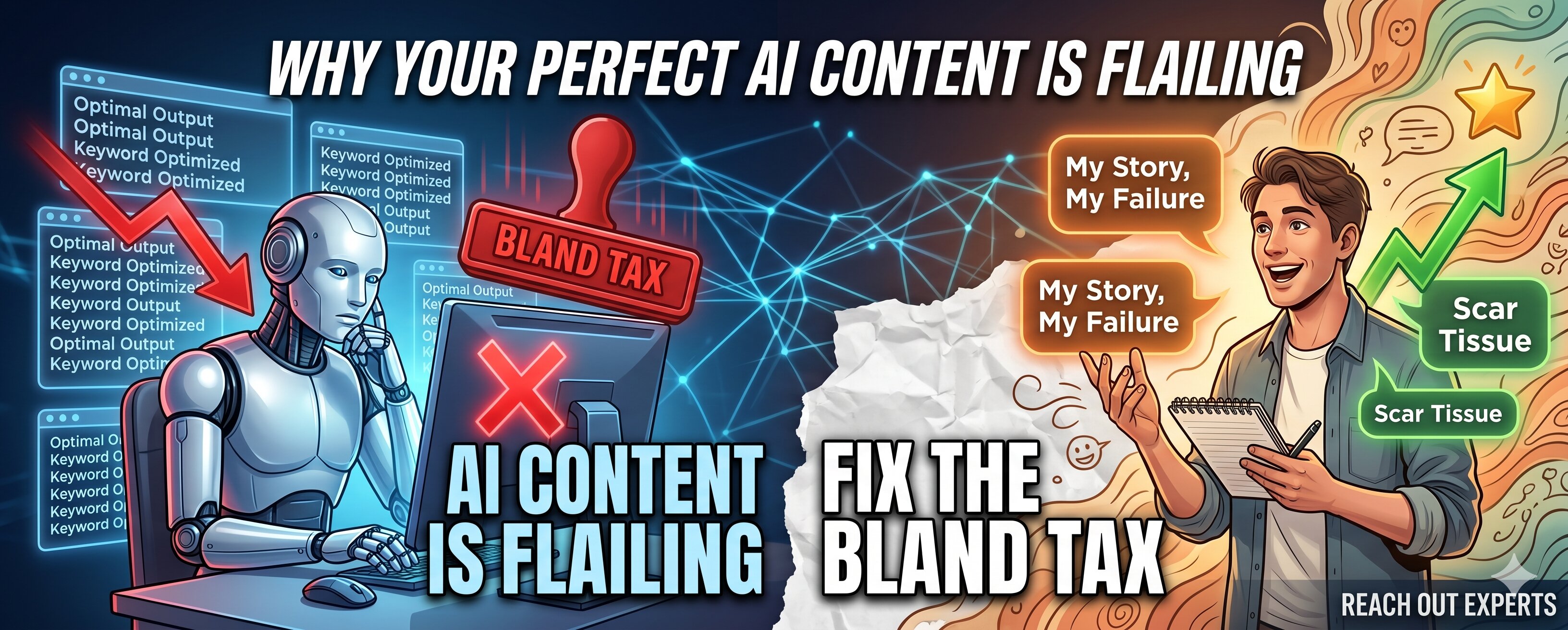
You just spent three hours tweaking the perfect prompt to write a guide on The Best Business Laptops. It’s clean, it’s comprehensive, and the grammar is flawless.
But when you check the search results, your masterpiece is stuck on page four. The number one spot? A messy, raw forum post where someone rants about how their laptop hinge snapped during a bumpy flight.
Why does this happen? The truth is, search engines aren't looking for "perfect" anymore. They are looking for the scar tissue of real experience.
Now that the Google March 2026 Core Update rollout is complete, we are seeing exactly what it takes to win. Let's break down why your clean content is dropping, and how you can fix it right now.
What exactly is the “Bland Tax”? (And why is Google charging you?)
Over the last few weeks, the Google Search Status dashboard recorded massive ranking shifts. If your traffic dropped, you are likely paying the "Bland Tax."
This just means Google is actively punishing boring, copy-paste content. Since anyone can click a button and generate a perfectly okay article, "okay" is no longer good enough.
Instead, the algorithm now looks for User Persistence. This means it rewards pages where real people stay, read, and interact because they found something truly unique.
Here is a simple look at how the rules have changed:
| The Old Way: High Volume & Low Soul | The New Way: Persistence & Personality |
|---|---|
| Writing generic facts anyone can guess. | Sharing specific, hard-learned lessons. |
| Making sure every keyword is placed perfectly. | Keeping readers on the page longer with unique stories. |
| Trying to sound like a giant corporate brand. | Sounding like a real human who actually used the product. |
The “Robot Smell” Audit: How to tell if your site is being taxed
Most business owners don’t realize their writing sounds like a machine until it's too late. You need to read your latest post and check for the classic signs of AI-generated fluff.
Run your content through this quick checklist. If you see these red flags, you have a problem:
- 🚩 The Boring Intro: Does it start with something like, "In today's ever-changing world of..."? If yes, humans will instantly click away.
- 🚩 Zero Opinions: Does the article play it too safe? If you never take a firm stance or point out a flaw, it lacks a human touch.
- 🚩 No "I" or "We": If the entire post is written in the third person without a single personal story, it feels cold and robotic.
- 🚩 The Useless Summary: Does the article end with "In conclusion, choosing a laptop is important..."?
If your site smells a bit too much like a robot, don't panic. You can fix this by following our guide to balancing AI efficiency with brand voice to get your personality back on track.
The “I” Statement Pivot: Adding “Scar Tissue” to your advice
The easiest way to stop paying the Bland Tax is to shift from giving theoretical advice to sharing your actual experience. This proves to search engines that you actually know what you are talking about.
Sharing your own stories is the easiest way to show off your real-world expertise (E-E-A-T). It takes only a few seconds to rewrite a boring sentence into an expert sentence.
Take a look at this simple pivot:
💬 Before (The Bland Way):
(Boring, obvious, and could have been written by anyone.)
When traveling, laptops should be lightweight and have a long battery life.
💬 After (The Human Way):
(Unique, helpful, and proves a human actually touched the product.)
I carried this laptop through three airport terminals last Tuesday, and my shoulder didn't ache once. Plus, the battery survived a five-hour delay.
Beating the Sidekick: Writing for the Parallel Browser Era
Here is the biggest shift nobody is talking about: Google is now testing a native AI Sidekick inside Chrome. This means users are reading an AI-generated summary right next to your web page.
If your page just repeats the same basic facts as the AI sidebar, the reader has no reason to look at your site. To survive, your content actually has to match Google's focus on helpful, people-first content by offering something the AI simply cannot guess.
Here is how to hook a reader away from the AI summary:
- Drop a "Deep Hook" early: Put your most surprising data point or strongest opinion directly in the first 100 words.
- Front-load the answer: Do not make people scroll to the bottom to find the main point. Give them the answer immediately, then use the rest of the page to explain why.
- Highlight human failure: AI rarely talks about mistakes. Share a story about a time you messed up and what you learned. The sidekick won't summarize this, so readers have to read your page to get the juicy details.
The “Scroll-Stop” Sidebar: A 5-Minute Fix for Mobile Users
Because search engines want to see "User Persistence," you need to stop mobile users from mindlessly scrolling past your best advice. Long walls of text are your worst enemy here.
You can fix this easily by adding a "Human-Only Sidebar" to your pages. This is a bright, colorful box that breaks up the text and forces the reader to pause.
Here is exactly how to build one today:
- Pick your best article: Find a post that gets decent traffic but feels a little boring.
- Find a natural break: Scroll halfway down the page where the text gets heavy.
- Insert a colored text box: Use a bright yellow or light grey background so it pops out on a phone screen.
- Add a personal tip: Title the box "What I Learned the Hard Way" or "My Honest Pro/Con List."
- Keep it punchy: Write three quick sentences about your personal experience with the topic.
This simple visual trick keeps eyes on your page longer. For more layout tricks like this, check out our best practices for designing for mobile skimmability.
Frequently Asked Questions (The Quick Recap)
Does this mean I have to stop using AI for writing?
Not at all! AI is amazing for brainstorming, outlining, and doing the heavy lifting of your first draft. Just make sure a real human comes in at the end to add personal stories, opinions, and that essential "scar tissue."
Will my old "perfectly optimized" articles keep dropping in rank?
If they are completely generic and lack a unique perspective, yes, they probably will. Google is getting much better at ignoring pages that just repeat what everyone else is saying.
What is the fastest way to fix a page that was hit?
Go to the very first paragraph of the page. Add a personal story, a unique data point, or a strong opinion right at the top. This instantly shows both the reader and the search engine that a real person wrote it.
Why does Google prefer Reddit over my professional blog?
Reddit is full of real, messy human conversations. When people search, they often want to know what a community of real users thinks, rather than reading a polished sales pitch. You need to bring that same conversational honesty to your blog.
How do I know if the Chrome AI Sidekick is summarizing my site?
Open the Chrome browser, search for your main keyword, and open your article. If the AI panel opens on the side, read its summary. If the summary gives away everything in your article, you need to add deeper, more personal hooks to your text.
Is "User Persistence" a real ranking factor now?
Google doesn't explicitly use the phrase "User Persistence" as a named metric. However, their latest updates strongly reward the behavior of persistence. If users stay on your site, read deeply, and don't immediately bounce back to the search page, your rankings will improve.
Related Blogs

Human–AI Collaboration Marketing
Learn how humans and AI work together in marketing using hybrid workflows, examples, tools and best practices
Read more
How to Mix AI and Human Content
Learn how to blend AI and human writing with a hybrid content workflow for accuracy, creativity, trust and SEO success.
Read more
AI Content Creation Workflow
Building a reliable AI content creation workflow isn't about replacing your team with robots
Read more